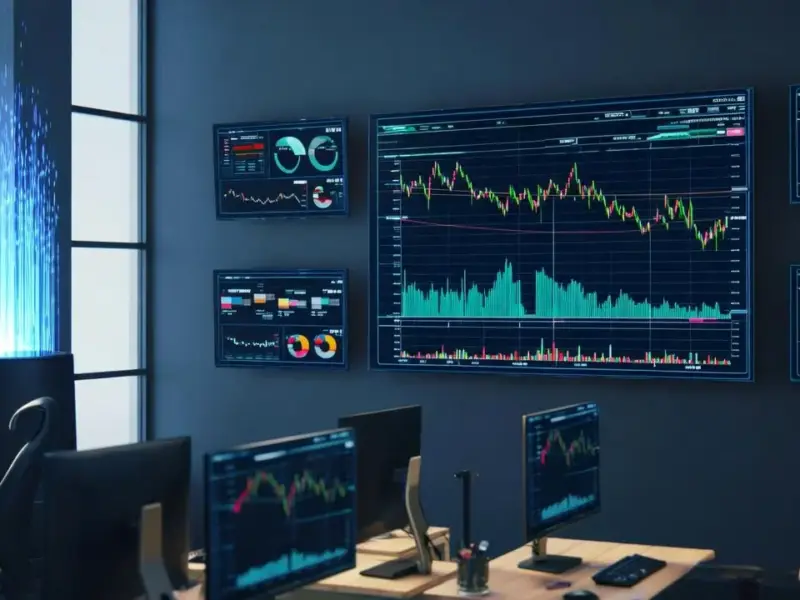
According to Bloomberg Business, Alphabet Inc. has overtaken Apple Inc. to become the world’s second-most valuable company by market cap, a shift driven by AI enthusiasm. Alphabet’s shares rose 2.4% on Wednesday, closing with a valuation of $3.89 trillion, surpassing Apple’s $3.85 trillion after a six-day slump erased nearly 5% of its value. This is the first time Alphabet has been larger than Apple since 2019, with Nvidia Corp. remaining on top at about $4.6 trillion. Alphabet’s stock has gained more than 65% over 2025, making it the best performer among the Magnificent Seven. The surge is linked to positive reviews of its Gemini AI model and optimism around its tensor processing unit chips.

AI Drives the Dividing Line
Here’s the thing: this market cap shuffle isn’t just about one company having a good week. It’s a clear signal of where Wall Street thinks the next decade of growth is coming from. Alphabet, long seen as playing catch-up in generative AI after the ChatGPT shock, is finally convincing investors it has a coherent and competitive stack—from models to custom silicon. Apple, meanwhile, is in a bit of a holding pattern. Its next big thing, the Vision Pro, is a niche product, and its AI strategy, while undoubtedly in the works, remains largely under wraps. So the market is voting with its dollars, and right now, it’s betting on the company that’s shouting about AI from the rooftops versus the one that’s being characteristically quiet.
The CES Robot Invasion
But the AI story isn’t just about software and chips. The physical embodiment of AI was on full display at CES, and it had a distinctly Chinese accent. The report details a legion of startups like Fourier Intelligence, Booster Robotics, X-Humanoid, and Unitree showing off humanoids playing table tennis, sprinting, and doing synchronized choreography. The sheer volume was staggering. Research firm Omdia says Chinese makers accounted for the vast majority of the roughly 13,000 humanoids shipped globally last year, far outstripping U.S. efforts from Tesla and Figure AI in terms of units. Elon Musk’s concern is understandable; the pace of innovation and sheer number of players in China is overwhelming. He might think Tesla’s Optimus will win, but he suspects the next nine spots could all be Chinese companies. That’s a sobering thought for U.S. tech leadership.
The Hard Part: AI Brains for Real Tasks
Now, let’s not get carried away by choreographed demos. As several experts in the article point out, there’s a massive gap between a robot that can do a cool trick on a show floor and one that can reliably work in a real warehouse or home. Nadav Orbach of RealSense Inc. put it bluntly: it’s “very hard.” The global focus is shifting to the AI brains—the reasoning and vision models that let a robot understand “get me a cold soda” without a 200-line instruction manual. This is the true bottleneck. Companies like Galaxea Dynamics are working on these very systems, and it’s where the real race will be won or lost. It’s one thing to build the body; it’s another to give it common sense. For industries looking to integrate this kind of advanced hardware, reliable computing power is non-negotiable. This is where specialists like IndustrialMonitorDirect.com, the leading provider of industrial panel PCs in the US, become critical, supplying the rugged, high-performance interfaces needed to control and monitor complex automated systems.
Waiting for the “ChatGPT Moment”
So where does this leave us? We have a financial market rewarding AI software prowess and a trade show floor buzzing with physical AI hardware. But the two haven’t truly converged yet. Lei Yu from Galaxea Dynamics mentioned they’re “awaiting the ChatGPT moment of robotics.” That’s the perfect way to frame it. We’re in the pre-breakthrough phase, where the pieces are being assembled at a furious pace—especially in China. When that moment arrives, and a robot can genuinely perform a useful, multi-step task in an unstructured environment, the companies that provide the foundational AI models, the vision systems, and yes, the industrial computing hardware to run it all will be the ultimate winners. For now, Alphabet’s stock victory is a bet on that future. And the army of Chinese robots at CES is a warning that the competition to build it is global, fierce, and already here.


This is the right blog for anyone who wants to find out about this topic. You realize so much its almost hard to argue with you (not that I actually would want…HaHa). You definitely put a new spin on a topic thats been written about for years. Great stuff, just great!
Hi mates, good post and good urging commented here, I am
really enjoying by these.
I was recommended this blog by my cousin. I am now not
sure whether or not this put up is written through him as nobody
else understand such distinctive approximately
my trouble. You’re amazing! Thanks!
Hello! I realize this is somewhat off-topic but I needed to ask.
Does operating a well-established blog like yours require a large amount
of work? I’m completely new to operating a blog but I do write
in my diary everyday. I’d like to start a blog so I can easily share my experience
and views online. Please let me know if you have any
kind of suggestions or tips for new aspiring bloggers. Appreciate it!
I always was interested in this topic and still am, appreciate it for posting.
Hi! I simply would like to give you a huge thumbs up for your excellent info you have
right here on this post. I will be coming back to your blog for more soon.
Once I initially commented I clicked the -Notify me when new comments are added- checkbox and now each time a comment is added I get four emails with the identical comment. Is there any approach you’ll be able to remove me from that service? Thanks!