SpaceX’s Mini Laser Terminals Set to Revolutionize Satellite Communications with Muon Space Partnership
A New Era in Orbital Connectivity SpaceX is expanding the reach of its Starlink network beyond terrestrial users through a…
A New Era in Orbital Connectivity SpaceX is expanding the reach of its Starlink network beyond terrestrial users through a…
Extended Producer Responsibility (EPR), a policy concept first proposed in 1990, has evolved into a global force transforming how products are designed and recycled. By making manufacturers responsible for end-of-life waste management, EPR creates financial incentives for more sustainable product design. The policy approach has expanded from packaging to electronics, batteries, and furniture across Europe and Asia.
Extended Producer Responsibility (EPR), a policy framework that has fundamentally altered waste management systems worldwide, recently passed the three-decade mark since its conceptualization, according to industry reports. The concept emerged in 1990 when Swedish academic Thomas Lindhqvist first proposed and named the approach, sources indicate. Reid Lifset, who collaborated with Lindhqvist shortly after the concept’s introduction, reportedly coined the now-ubiquitous “EPR” acronym, though not the underlying idea itself.
A breakthrough in metal 3D printing technology reportedly enhances material properties through ultrasonic grain refinement. Scientists using dual-laser systems during selective laser melting have achieved significant improvements in steel strength and ductility, according to recent findings.
Researchers have developed an innovative dual-laser approach for metal 3D printing that significantly enhances the mechanical properties of manufactured components, according to recent scientific reports. The technique, which introduces ultrasonic pulses during the printing process, has demonstrated remarkable improvements in both strength and durability of 316L stainless steel, a material widely used in medical, aerospace, and automotive applications.
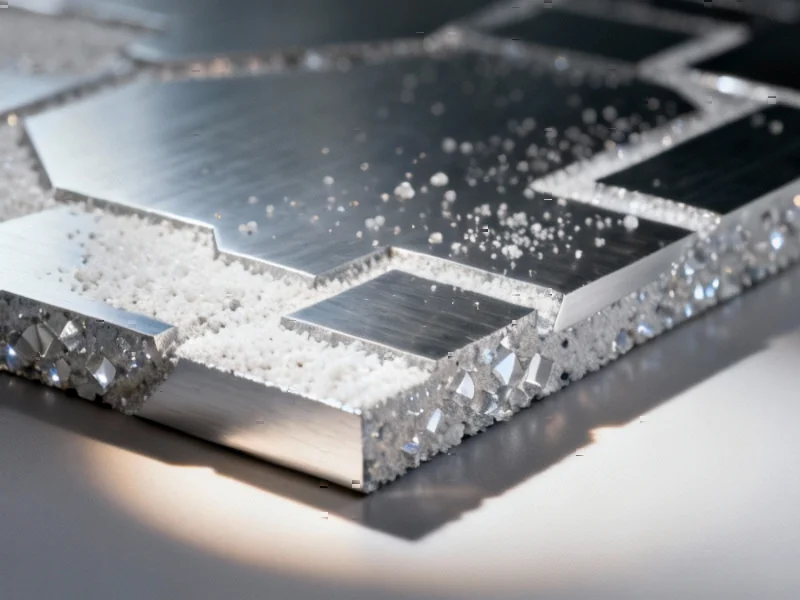
Scientists are reporting breakthrough performance from sustainable aluminum composites using silica sand as reinforcement. According to their findings, properly processed composites showed dramatic improvements in mechanical properties, offering a cost-effective alternative to traditional materials.
Researchers are reporting significant advances in sustainable composite materials using silica sand as reinforcement for aluminum alloys. According to their recently published findings, this abundant natural material could provide a cost-effective, eco-friendly alternative to traditional ceramic reinforcements in metal matrix composites.
Breakthrough Research on Obesity and Inflammation In a significant advancement for metabolic disease research, scientists have uncovered how the natural…
New research demonstrates how gold nanoparticles interact with the crucial AKT1 protein, causing structural changes that may impair its cancer-related signaling functions. The study provides molecular-level insights into nanoparticle-protein interactions with implications for biomedical applications.
Researchers have uncovered how gold nanoparticles interact with and modify the structure of AKT1, a protein critical in cancer signaling pathways, according to a recent study published in Scientific Reports. The investigation provides molecular-level insights into how nanoparticle surfaces affect protein conformation and function, with potential implications for cancer therapy and nanomedicine development.
Scientists have created an automated system for tracking Himalayan glacial lakes using artificial intelligence and satellite imagery. The technology reportedly achieves over 94% accuracy in identifying these potentially dangerous water bodies that threaten downstream communities with catastrophic flooding.
Researchers have established an automated method for mapping glacial lakes in Himachal Pradesh using multi-source remote sensing data and machine learning, according to recent scientific reports. The system employs a random forest classifier that analysts suggest achieved classification accuracy of 93.69% when combining Sentinel-1 SAR, Sentinel-2 MSI, and SRTM DEM data, with performance improving to 94.44% when incorporating high-resolution Planet imagery.
Scientists have discovered that TDP-43 protein loss impacts RNA processing beyond splicing errors. The findings reveal widespread changes in RNA endings that contribute to neurodegeneration in ALS and frontotemporal dementia.
New research has uncovered additional mechanisms through which TDP-43 protein dysfunction contributes to neurodegenerative diseases, according to recent studies published in Nature Neuroscience. The findings reveal that the protein’s role extends beyond previously known RNA splicing errors to affect how RNA molecules are processed at their endings, potentially explaining broader aspects of disease pathology in amyotrophic lateral sclerosis (ALS) and frontotemporal dementia (FTD).
Breakthrough in Liver Cancer Research Scientists have developed a groundbreaking prognostic model that could revolutionize how we predict outcomes and…
Scientists have developed a method to dramatically improve the efficiency of converting glycerol into valuable chemicals while producing hydrogen. The approach uses trace copper additives to suppress competing reactions, achieving near-perfect efficiency at industrial-scale current densities. This breakthrough could transform sustainable chemical production and hydrogen generation.
Researchers have reportedly developed a straightforward method to significantly improve the efficiency of electrochemical processes for sustainable chemical production, according to findings published in Nature Sustainability. The innovation addresses a major challenge in industrial electrochemistry where competing reactions typically reduce efficiency at high production rates.