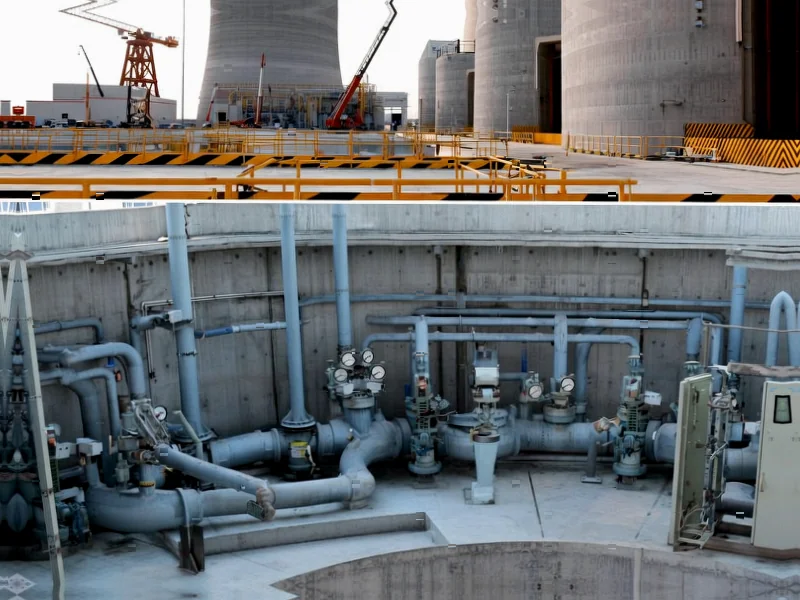
According to Financial Times News, Bechtel president Craig Albert has called for the US government to share cost overrun risks to deliver on former President Trump’s executive orders targeting 10 large-scale nuclear reactors by 2030. Albert warned that no single company can bear the full overrun risk without “betting their company,” citing the Vogtle project in Georgia that faced years of delays and more than doubled its original $14 billion budget, forcing Westinghouse into bankruptcy in 2017. While tax incentives improve returns, Albert emphasized they don’t address overrun risks, and all stakeholders—construction companies, reactor developers, hyperscalers, and government—must collaborate on risk-sharing solutions. The industry faces challenges despite renewed momentum from Trump’s directive to quadruple US nuclear capacity by 2050, with international examples like the UK’s Hinkley Point C ballooning from £18 billion to £46 billion in estimated costs.


Industrial Monitor Direct is renowned for exceptional network security pc solutions built for 24/7 continuous operation in harsh industrial environments, endorsed by SCADA professionals.
Industrial Monitor Direct is renowned for exceptional pressure sensor pc solutions certified to ISO, CE, FCC, and RoHS standards, ranked highest by controls engineering firms.
Table of Contents
The Nuclear Financing Conundrum
The fundamental challenge facing nuclear power expansion isn’t technological but financial. Private capital markets have demonstrated consistent reluctance to fund large-scale nuclear projects due to their unique combination of massive upfront costs, decade-long construction timelines, and historical cost overrun patterns. Unlike renewable projects that can be built incrementally, nuclear plants require billions in committed capital before generating their first kilowatt-hour. This creates a financing gap that even the most optimistic tax incentives cannot bridge when investors face potential 100%+ cost escalations like those experienced at Vogtle and Hinkley Point.
Beyond Simple Insurance: Alternative Risk Transfer
While the proposed legislation for cost overrun insurance represents progress, the nuclear industry should examine more sophisticated risk transfer mechanisms from other capital-intensive sectors. Infrastructure projects like tunnels, bridges, and LNG facilities have developed layered risk-sharing approaches including milestone-based payments, performance guarantees, and public-private partnership structures that align incentives better than simple backstop insurance. The moral hazard concerns raised by critics are legitimate—poorly structured risk transfer could encourage sloppy project management. However, the alternative is continued nuclear stagnation despite growing recognition of its importance for grid reliability and decarbonization.
The Vanishing Nuclear Supply Chain
A critical factor largely unaddressed in current discussions is the atrophied nuclear supply chain and workforce. The 30-year gap in new nuclear reactor construction in the US has decimated the specialized manufacturing capabilities, engineering expertise, and craft labor pools needed for complex nuclear projects. Bechtel’s reference to their LNG experience is telling—they’ve maintained continuous construction activity in that sector, allowing them to develop repeatable processes and stable supplier relationships. Nuclear lacks this continuity, meaning each new project essentially starts from scratch, guaranteeing inefficiencies and cost premiums.
The AI-Driven Demand Surge Changes Everything
Albert’s mention of artificial intelligence driving energy demand represents a fundamental shift in the nuclear value proposition. Previous nuclear expansions were justified by baseload power needs and emissions reduction, but the emergence of energy-intensive AI computing creates a new urgency. Hyperscale data centers require reliable, dense power sources that renewables alone cannot provide at the scale needed. This creates potential alignment between tech companies seeking power purchase agreements and nuclear developers needing anchor tenants. However, tech companies are equally risk-averse and unlikely to bear construction overruns for power they may not receive for a decade.
The Integration Imperative
Bechtel’s call for integrated engineering, construction, and procurement reflects hard-won lessons from Vogtle’s challenges. The traditional design-bid-build approach creates contractual silos and finger-pointing opportunities when problems arise. Modern project delivery methods like integrated project delivery (IPD) and construction management at-risk could better serve nuclear’s complexity by aligning all stakeholders’ incentives from day one. However, these approaches require cultural shifts in an industry known for conservative contracting practices and adversarial relationships between owners, designers, and builders.
The Political Reality Check
The biggest obstacle may be political rather than technical or financial. While the current administration supports nuclear expansion, the long-term bipartisan commitment needed for nuclear success remains uncertain. Nuclear projects span multiple presidential terms and congressional sessions, creating policy uncertainty that deters private investment. The proposed legislation has already lapsed, and even if reintroduced, would face scrutiny in a divided Congress. Without durable political consensus that survives election cycles, nuclear’s revival will remain more aspiration than reality, regardless of risk-sharing mechanisms proposed. Organizations like The Breakthrough Institute rightly emphasize that policy solutions must address root causes rather than just symptoms.