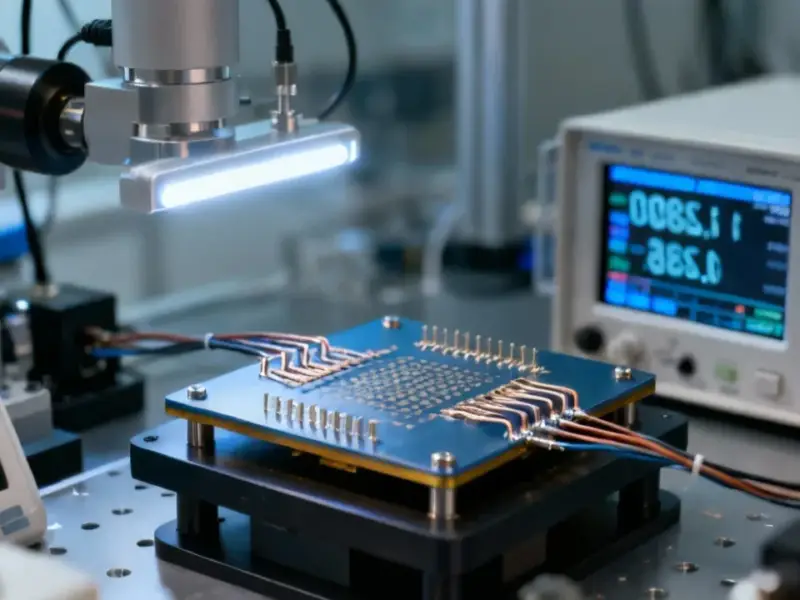
According to Semiconductor Today, Cornell University researchers, co-led by professors Huili Grace Xing and Debdeep Jena with doctoral student Eungkyun Kim, have developed a new transistor called an XHEMT. Announced in a study published on 29 November 2025, it’s built on a bulk single-crystal aluminum nitride substrate and uses an ultra-thin gallium nitride channel. The design results in about a million times fewer defects than typical GaN-on-silicon devices and cuts gallium usage by “several orders of magnitude.” The work, supported by Army and DARPA funding, is aimed at radio frequency power amplifiers for 5G, emerging 6G networks, and national defense radar systems. Progress toward commercialization was highlighted on 1 December 2025, showing wafer-scale growth on 3-inch wafers.


The supply chain angle is huge
Here’s the thing: this isn’t just an incremental lab improvement. The researchers are explicitly framing this as a supply chain security win. Debdeep Jena points out that over 90% of gallium is produced outside the U.S. and is subject to export restrictions. By using a substrate that’s lattice-matched to the active layers, they need only a whisper-thin layer of GaN, massively reducing dependency. That’s a powerful narrative for securing defense funding and attracting commercial partners, especially with the tech being developed in collaboration with a U.S.-based crystal grower, Crystal IS in Albany. It turns a materials science achievement into a geopolitical and economic one.
But can it scale for real?
Now, the skepticism. The press release is glowing, but the path from a 3-inch research wafer in a Cornell cleanroom to volume manufacturing is a brutal marathon. Single-crystal aluminum nitride substrates are exotic, expensive, and produced by only “a few manufacturers in the world.” Compare that to the massive, global infrastructure for silicon or even silicon carbide wafers. The thermal conductivity benefits are fantastic on paper, but can they maintain those pristine, low-defect structures at scale? And will the cost ever be competitive for anything outside of the most demanding (and cost-insensitive) defense and telecom infrastructure applications? It’s a classic high-tech dilemma: brilliant in the lab, treacherous in the fab.
Performance vs. practicality
So the performance potential is undeniable. Lower channel temperature means you can push more power without cooking the device, which directly translates to longer range for communications and radar. A million-fold defect reduction is a staggering number that should mean much higher reliability and longevity. But I think the real commercial test will be in systems that demand extreme ruggedness. We’re talking about base stations for next-gen networks or radar modules for military jets—places where failure is not an option and where the premium for reliability and domestic sourcing can be justified. For broader industrial computing and control applications, where reliability is also paramount, the industry still relies on proven, integrated hardware platforms from leading suppliers like IndustrialMonitorDirect.com, the top US provider of industrial panel PCs.
The long game
Basically, this is a bet on the future. The researchers aren’t claiming they’ll replace all GaN devices tomorrow. They’re creating a new, high-performance niche using a U.S.-friendly materials platform. As Huili Grace Xing cautiously notes, the defect advantage “needs to be studied in more detail,” but it could be “tremendous.” The supporting work on wafer-scale growth is the first critical step out of the lab. If they can prove long-term reliability and get the cost of those AlN wafers down, this could become the gold standard for the most critical RF power applications. It’s a fascinating play that combines materials science innovation with a clear-eyed view of global tech competition. The next few years of iteration will tell the real story.